
6 Step Guide – Driving School Marketing Plan for Facebook
Is Facebook a part of your business marketing strategy? Love it or hate it, you would be wise to invest some time in Facebook, as that’s where many of your potential customers are spending their time! Furthermore, many of your competitors are undoubtedly reaping the rewards of Facebook marketing – and if you’re not, you are losing out.
Are you stuck using the ‘old skool’ way of advertising and marketing your driving school, e.g. leaflet drops, advertising in shop windows, local newspaper and magazine adverts, Yellow Pages, Thomson Local? This type of marketing has its pitfalls – it can be very expensive to advertise in local media and directories and very time-consuming to traipse around your town delivering leaflets and postcards. Let’s face it, leaflets are generally perceived as more of a nuisance than a help to homeowners, so they might actually do more harm than good!
If you are using these strategies and you are seeing a good return on investment – great! Keep doing it. But if you’re looking to further increase your client-base and pupil numbers, definitely take a look at Facebook. It’s easy, accessible from your computer or mobile devices, and (for the most part) FREE!
Facebook can help significantly boost your profile
Most ADIs will admit that the best form of marketing is through word-of-mouth recommendation. So there is no better way to spread recommendation than through social media channels, where hundreds, if not thousands of potential clients in your area can hear all about you and your business. Furthermore, when you get to learn more about Facebook, you can actually target specific types of people, from their age, interests and home town, right down to the college they attend and other Facebook pages they may like. You can even legitimately target Facebook ads at people who ‘like’ your competitors’ Facebook pages! But we’ll save that for a later blog article…
We’ve found that having a Facebook page for our driving school is one of the most significant factors in boosting our online presence within our target market. It has been a huge factor in us building a highly successful driving school with 23 instructors, all of whom have full diaries.
So what can you do and where can you get started with Facebook?
Having a Facebook business page is a great way of marketing but it isn’t just about marketing you and your brand. It’s about building trust, engaging with present and future customers and positioning you as a respected and successful instructor or driving school.
When using Facebook, your aim should be to educate, inspire, share stories and post valuable, relevant content. Then every now and again, promote yourself – post a special offer, post photos of pupils that have recently passed with you or your driving school.
Many driving instructors use their own personal profile as a marketing tool instead of having a separate business page. That can work quite well, but you need to understand the pitfalls of doing so, especially if you have not correctly set up your privacy settings to control which groups of your friends can see your content.
I personally use both my personal profile and my business pages for work. But the friends on my personal profile are allocated to specific groups, so I can control who sees what. When I post content or photos relating to something personal about holidays, nights out or my children, for example, ‘Family’ and ‘Close Friends’ see everything I post. ‘ADIs and PDIs I know’ see a little less. ‘Other ADIs and PDIs’ see less still. Those listed under ‘Restricted’ and ‘Limited Profile’ see very little at all. And last but not least, those listed under my ‘Weirdos’ category won’t see any of my non-public content at all!
 There are also many advantages of using a Facebook business page – insights, customer star ratings, reviews and advertising being just a few. For a list of 14 benefits of a Facebook Business Page over a Personal Profile, take a look at this excellent article by Jon Loomer.
With more and more people accessing Facebook on their mobile, and especially our target market of 17-25 year olds, can you really afford not to put your face on the book?
Here’s your simple 6-step guide to setting up a Facebook business page
(This guide assumes you are using the Facebook website directly rather than via a mobile app):

 In the Facebook header bar, click on the drop down arrow on the far right and click ‘Create Page’. It’s probably best to opt for a ‘Local Business or Place’ as you will be wanting to let people know where you are based. Although your address will show on your page, you don’t have to add your house number if your work address is the same as your home address. On the category dropdown list, just opt for ‘Local Business’ for now. Complete all your details and click ‘Get Started’.

 On the next page, you will be prompted to provide some more details about your business. You can now select ‘Driving School’ from the category section, complete the ‘about section’ and add in your website address. Also on this page, you can choose a unique Facebook web address to make it easier for people to find your Page. Make sure your URL has your driving school name, not just the default Facebook generated URL. Your Facebook address should be formatted in the following way: www.facebook.com/yourdrivingschoolname. This will make it easier for your customers to find you on Facebook and it will help with your search engine optimisation (SEO) as Google ranks Facebook highly. For this reason, don’t be surprised if your Facebook business page appears above your main website in searches. This is great news if your actual website doesn’t rank highly just yet!
(If you already have an active Facebook business page and want to change your Facebook URL, go onto your business page and click ‘Edit Page’ at the top, then ‘Update page info’ and then click on ‘edit’ next to ‘Facebook Web Address’. Note that you can only change your Facebook URL once!)

 Choose an appealing profile picture. A smiley picture of you in your car will appeal to potential customers. People buy from people so make your page as personable as possible. Using your company logo isn’t usually a good idea – your potential clients aren’t interested in a logo – they want to see who they are going to be buying from. If you’re photo-shy or perhaps feel your photo might turn potential customers away, then perhaps use a photograph of a happy pupil, smiling broadly with their driving test pass certificate. Please don’t be tempted to rip a photo from Google images or use a stock photo – your profile image is your first point of contact from which your potential customers will glean their first impression. Make sure it’s a good one!
 Once your business page is set up, make sure you link your personal profile page to your business page. Then if people find you using your name, they can easily click through to your business page. To do this, go to your Facebook personal profile, click on ‘About’ and add your new page to ‘Work and Education’. Then on your personal profile, your business will be displayed in your about section and people can click straight through to your business page from your personal page.
 Make sure you also utilise the ‘About’ section on your business page. Let potential customers know that you can offer what they want. The about section also lets you add hours of opening, a contact number and links to other social media sites that you may use (Twitter, Pinterest, Google+, Instagram, etc). Make sure you include links to your company website.
 Use your cover photo wisely. Again choose an appealing photo for your cover but then add words including a clear call to action. For example, below you can see the cover photo we used this Spring on our Facebook business page – ‘Call us now and pass for Summer! 0161 345 3452’. Also make sure you add a description so when people click on the cover image there are more details and further calls to action, e.g. ‘Start learning now and take advantage of our great deals! Call us: 01234 567 890, Visit our website: www.drivingschool.com, Follow us on Twitter: @drivingschool’
 So that’s how to set up your Facebook page in 6 easy steps. Easy, wasn’t it?!
The next step is to start using your Facebook page to grow a fan base (‘fans’ being people who ‘like’ your page). Don’t worry if your ‘likes’ don’t grow overnight. It’s more about QUALITY than QUANTITY. The key is to grow a fan base of people in your coverage area who match your target market. This won’t happen by itself and you will need to invest some time into growing your business page. Look out for our upcoming article on how to build ‘likes’ and use your new Facebook business page effectively.
There’s so much you can do with Facebook. We haven’t even touched on insights, apps and Facebook Ads yet!
 What have been your experiences with Facebook? Have you been using it actively and what results have you got? Please post your comments below so that others can benefit.
Finally, if you liked this article, please share it by clicking one of the buttons below!
 Time is precious. And for driving instructors, lost time equals lost income. Using the top ten tips to Reduce Driving Lesson Cancellations can save you time and money. Yes, it’s great to be able to catch up on other essential business matters when last-minute lesson cancellations arise, but we all have bills to pay. So what can we do to minimise cancellations and loss of income? Here are 10 top tips:
 Outline the conditions for cancellation (see below) and end the conversation by simply asking for their verbal understanding, “so are we OK with that, or do you need me to clarify anything?”
  Make your terms and conditions easily available, have them on your website and appointment cards. Go through cancellation policies at the time of booking and/or on the first lesson. Even so, it can be hard to enforce and if reliable customers have a genuine reason for cancelling, waiving the cancellation on that occasion can make good business sense. You don’t want to lose an otherwise reliable customer all because you charged her for a lesson when she was in hospital with her son.
 “Yes Ged, I tell them that they have to give me 48 hours’ notice of any cancellations, otherwise I’ll charge them. But obviously if they’re ill, I don’t want their germs, so it’s fine to cancel then” When I asked him what the pupils’ reasons for cancelling that week was, can you guess what his reply was? Yes, you got it – “they’re all ill”. Hardly surprising, was it? It’s a good idea to waive the lesson fee if your pupil is genuinely poorly, but don’t tell them in advance that this will be the case, or else the same excuse will be used every time they just can’t be bothered with their driving lesson!
 When lessons are moved around a lot it’s easy for the pupil to ‘forget’ when their lesson was or double book that lesson time with some other commitment. Also, bear in mind that if you keep changing their lesson time around from week to week, they’ll expect you to allow them to do the same. Having said that, do bear in mind that learners will benefit from experiencing driving at different times of day, so moving a lesson time to another ‘regular slot’ for a few weeks should work well.
 It’s much easier to charge for cancellations when you have the money up front. Block booking discounts offer an incentive for customers to pay for 10 hours at a time, but is your incentive enough? We noticed a big difference in the amount of pre-payments for blocks of 10 hours when we put our hourly rate up but kept the block booking the same. Instead of a £10 discount, customers get £20 discount (almost the price of a 1 hour lesson!). Now customers are much more likely to take advantage of the £20 saving.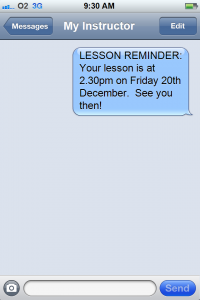
 Things have changed a lot in the 16 years I’ve been part of the driving instruction industry, and the way in which I have run my driving school has had to change keep up. One thing that hasn’t changed though is my definition of success.
 4 years later in 2001, I set up a driving school with a business partner, Glyn. We looked to build a multi-car school. This went from strength to strength, with 26 instructors at the height. So what did we do to ensure that outcome?
 Changes we made:
 What doesn’t work well?
 What can work:
 What does work (for us anyway!):