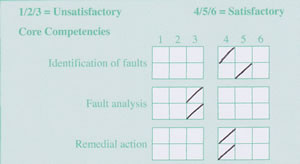
 “Hi Ged & Claire. I failed my ADI Part 3 test last week and the examiner told me that although I spotted all his faults and tried to fix them pretty well, my fault analysis needed work. But I’m not sure where I went wrong, because I did what my trainer had told me. For every fault, I asked him why he did it, but he just said, “I dunno” or “not sure”, and at one point he acted really defensive. Is my trainer right, or was my examiner just having a bad day?” Jim (PDI)
Fault Analysis ADI Part 3
Thanks for your question, Jim. Fault analysis, the second of the three main core competencies on the ADI Part 3 test and ADI Check Test, is often an area of weakness for PDIs and ADIs, so hopefully I can help clear things up for you!
To explain the basic principles of the core competencies in simple terms, imagine you have terrible stomach pain and decide to pay a visit to your local GP. After entering his room and briefly explaining your symptoms to the doctor (IDENTIFYING the problem), what would his next step be? Is he likely to ask:
a) “Why do you have stomach pain?” or
b) “When did the pain start? Where is the pain, specifically? Are there any circumstances in which it is better/worse?”
 In my experience, he would tend to go down the second route. In fact, if I was the patient and was asked “why do you have stomach pain?” I would almost certainly respond, “I dunno” or “not sure” (or maybe even “you’re the doctor, you tell me!!”). By taking the second route and asking a series of open questions, he is ANALYSING the problem far more effectively. Once he has determined what the cause of the pain is, he can then offer a REMEDY, possiblyin the form of a suitable prescription.
A GP’s livelihood (and often the life of his patient) depends upon a correct diagnosis, or ‘analysis’ of the patient’s symptoms. With driving instructors, unless they thoroughly analyse the cause of the mistake, they will rarely eradicate it completely, regardless of how much instruction he/she uses. This often results in frustration on the part of both the instructor and his/her pupil.
Hopefully, that has shed some light on the point the examiner was trying to make when you were asking the ‘pupil’ why he was making each mistake. In terms of the defensive attitude the examiner portrayed, just imagine you were learning a new skill and the teacher asked you, “why did you do that?” or “what did you do that for?” How might you react to those types of question?
 In driving instruction, fault analysis involves discussion of the CAUSE and EFFECT. As the instructor, you have two jobs to do when analysing a driver’s mistake:
1. Establishing the root cause of the mistake, and
2. Ensuring the driver is aware of the potential consequences of making that mistake.
Mistakes are generally caused by a deficiency in one or more of the following 3 areas: Knowledge, Understanding and where applicable, Judgement. Asking a series of relevant open questions will usually uncover the root cause of the error and their awareness of the effects. Here are some examples:
Knowledge – Does the pupil KNOW?
• When do you think would be the best time to signal if we’re taking the second road on the right?
• Where do we need to look before emerging from a junction?
• Where is it best to position on approach to a roundabout if we want to turn right?
Understanding – Does the pupil UNDERSTAND?
• In what ways might it be better/safer to…?
• What are the benefits/advantages of…?
• What is the importance of…?
• How did/could … affect other road users?
• How did/could … affect you?
Judgement – How does the pupil JUDGE it?
• How do you judge…?
• Where are you looking when…?
Once you have discovered the cause of the problem, and ensure they are aware of the potential consequences/effects, then you can go on to provide an appropriate amount of instruction to remedy the mistake.
I hope that helps! 🙂 Please feel free to share this article about Effective Fault Analysis ADI Part 3 with anyone.
