 In the first part of this article, we explored how to effectively develop our learner drivers’ mirror use. If you missed it, we’d strongly advise you read that part first – click here to read Part 1.
In the second part of this article, we will be looking further into the cyclic nature of the Look – See – Respond routine. Also, we’ll check out some higher level techniques to ensure your pupils not only continue to use their mirrors with better levels of understanding, but will learn to develop their own effective strategies to deal with situations arising behind them.
The ‘Silent Conversation’
In Part 1, we took some time to explore some examples of questions to use at the RESPOND phase of the routine. Although many instructors encourage their learners to look for cars, cycles or other vehicles behind or to the sides, it’s not these objects that cause crashes – it’s the driver of that vehicle that is responsible for their course of actions.
It can be helpful to consider the cyclic nature of the mirror routine as a ‘silent conversation’ between you and the other driver or rider. Not only do we need to respond appropriately to what we see in the mirrors, we also need to take into account how the driver/cyclist behind responds to our response. And having LOOKED and SEEN how they respond to our actions, we will then need to again RESPOND accordingly… and so it goes on!
So, assuming it’s daytime and you have a decent view of the driver behind, try asking your learner questions such as:
What’s the driver behind doing?
Is the driver behind paying attention?
What do you notice about the driver behind?”
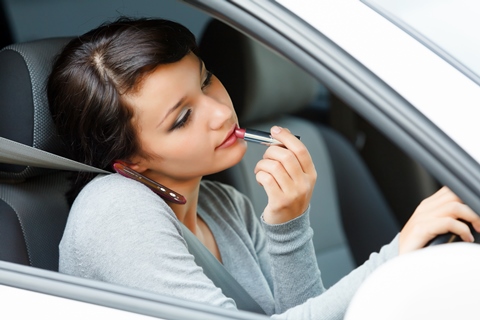 It may be that they are arguing with a passenger, distracted by their children, bopping away to a really good tune, lighting a cigarette, picking their nose (ewww!), texting/chatting on the phone, putting on makeup (okay, some women are distracted sometimes, too!). I’m sure we’ve all seen what other drivers do while at the wheel.
Once you’ve identified what the driver is doing, explore how this will affect your pupil’s decisions – in effect, how they will ‘communicate’ with that driver. You could ask:
How can we make allowances for him?
What can we do differently with our speed on the approach to these lights?
How early should we start signalling for our turn?”
Once the learner has replied to your question and/or taken action, encourage them to LOOK and SEE how the other driver has RESPONDED to our ‘communication’:
What’s happening behind now?
Have they recognised what we’re doing?
How is he responding / What is he doing now?
Do we need to do anything else now?”
A painful experience
A few years ago, one of my former franchised instructors was giving a lesson to one of his pupils. During this lesson, they had a crash which could potentially have resulted in very serious injury or even a fatality.
The learner driver was just a few weeks away from taking his driving test. During this particular lesson, he was approaching a zebra crossing with a pedestrian walking towards it. The instructor was watching the learner driver to see if he had checked the mirrors. On noticing the learner’s lack of mirror use, the instructor failed to intervene, because (in his words after the crash) “he had his driving test booked and should have known what to do!” There was no mirror check or any early positive indication that the learner had seen the crossing or the approaching pedestrian.
Only at the last moment did the learner driver see the pedestrian. He then slammed on the brakes… hard.
 Meanwhile, the learner and instructor had both failed to realise was that there was an enormous quarry lorry close up behind them. Needless to say, when the learner driver slammed on the brakes the lorry couldn’t stop in time. The lorry crashed heavily into the back of the instructor’s car pushing it through the zebra crossing. Fortunately the pedestrian hadn’t started crossing – imagine the outcome if they had 🙁
This whole situation could have easily been averted. Regardless of the standard of the learner driver, it is always the instructor’s responsibility to keep everyone safe. On identifying the pedestrian crossing early and failing to see any response from the learner driver, the instructor could (and should) have asked something along the lines of:
What hazards do we have up ahead?
How close is the truck behind?
What will you do with your speed?
How is the driver behind responding?”
Developing Coping Strategies:
I’m sure most of us have experienced how learner drivers can get flustered with drivers following closely behind. We explored this more fully in our ‘Dealing with aggressive tailgaters’ article. As covered in that article, you may want to explore how to get out of the way if the driver behind seems totally distracted. By doing so, they are no longer a concern, especially if your pupil seems on edge about having them behind. In both of the examples below, the ‘silent conversation’ between me and the driver behind helped avoid potential crashes…
Example 1: Looking for a POSITIVE RESPONSE
Whilst driving home from work recently, the driver of a supermarket delivery van was following about an inch from my bumper (OK, so that might be a slight exaggeration, but he was still really really close!) I could see that he was occasionally glancing at the road but that most of his attention was directed at something on the passenger seat – maybe his delivery schedule.
My first thought was, “I don’t want this guy behind me; I’ll pull up and let him pass”. I didn’t pull up as normal though – I signalled left and kept my speed at 30 mph. I continued to drive until I got a positive response. I saw that he had seen my signal because he began looking in his right mirror to look for an opportunity to pass me. Only then did I slow down to pull up – he ‘spoke’ to me before I responded. Had I not waited for the positive response and reduced my speed before he recognised my signal and intention to pull over, I would undoubtedly have ended up with an embarrassed van driver and a ton of groceries in my boot!
Example 2: Using observation links
A couple of years ago, whilst waiting to turn right into a side road, I saw a car approach a T-junction further up the road. It shot straight over the give way lines and only stopped when almost at the centre line on the major road! I made my turn and watched in my mirrors to see if the car would turn into the road behind me. It did. Before reaching the end of the road where there was a mini roundabout with just a left or right exit to choose from, I instinctively decided to turn into an empty car park without losing much speed, as I didn’t want the car behind to get too close to me.
The driver behind may have not have stopped at the previous junction for a number of reasons – perhaps he didn’t realise it was a give way junction? Maybe he was distracted, drunk or under the influence of drugs? Regardless of his reasons for doing so, I wasn’t feeling comfortable being in front of him so I turned off as soon as I could.
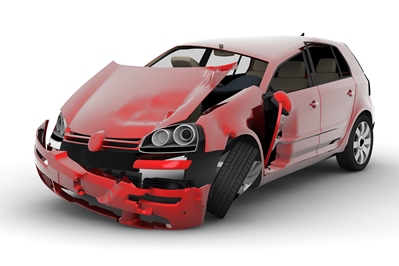 So what happened next? He continued to the roundabout, failed to stop and drove straight into the lamp post on the other side of the roundabout!
These are just 2 examples of when crashes may have been averted (away from me anyway!) by using the LOOK – SEE – RESPOND – LOOK – SEE – RESPOND cycle. These examples also illustrate the importance of using ‘observation links’ within this cycle (clues as to what other road users are likely to do next). This is what our pupils need to be able to do as well. They need to interpret the other driver’s response in our ‘silent conversation’ – does the driver behind recognise what you’re doing? Is he responding appropriately or is he ignoring you?
ATTITUDE WARNING!
 Sometimes, thought-provoking questions relating to the behaviours of drivers behind can highlight your learner drivers’ poor attitudes towards other road users. Your learner may scold the driver behind for using his mobile phone or for driving too closely, or for whatever other bad habit the driver behind is displaying. Instead of displaying similar levels of aggression by rebuking the other drive, think how you could use the other driver’s behaviours as a valuable learning opportunity.
What effect could that have on him? What about us? What could be the possible consequences?
You could then ask your pupil to identify what possible ‘bad habits’ they may develop once they’ve passed the driving test? Just how attached are they to their phone? What if it rang whilst they were driving? In what situations might they be tempted to answer it? How are they for time-keeping? What if they were running late for work, an interview, appointment or party? How rowdy are the friends that they will be offering lifts to? How might that impact their driving? What strategies will they have in place to deal with it?
Are you up for the challenge?
 Let’s look back at the example questions we provided in Part 1 of this article when encouraging your pupils to LOOK and SEE what’s there…
What’s going on behind?
How close is the car behind?
How fast is the car behind going?
Are there any bikes coming down on our left?
Is there anything overtaking us?”
What’s missing from all these questions? That’s right – the word ‘mirror’ isn’t mentioned at all. Our challenge to you would be to try and eliminate repetitive reference to the ‘mirrors’ from your everyday teaching and instead to use awareness questions. You can start doing this from the very first lesson!
‘Bottom-up’ instruction
Try to avoid the ‘bottom-up’ approach to teaching. This is a typical trait of some PDIs and ADIs (especially those training for Part 3 or who have recently qualified). For example, when teaching their pupils how to move off, they will often instruct in the following way:
Have a quick check in your centre mirror, then check your left blind spot, left door mirror, centre mirror again, the road ahead, right door mirror, and your right blind spot”
This simply gets the pupil to LOOK, but no further parts of the routine are explored. Some lessons later, the instructor goes on to help their learners understand what they’re looking for (SEE) and then some will get around to exploring how the learner driver should RESPOND to what they see in the mirrors.
 Other bottom-up approaches include encouraging the pupil to routinely apply the right signal when moving off for the first time (“just for practise”), rather than to LOOK, SEE and RESPOND appropriately to what is around us at the time. Read our article on signalling for more guidance 😉
Unfortunately, such short cuts make life MUCH harder for the ADI and the learner in the long run – the bad habit of just looking blankly in the mirrors will have already formed from those early lessons and may be very hard to break at a later stage. This is why we may often see the pupil quickly glance at the mirrors (and apply the right signal), but we know full well that they cannot possibly have had the opportunity to fully assess what they can SEE (and therefore signal accordingly).
‘Top-down’ instruction
Top-down teaching, on the other hand, is where we would start with the reasons for effective all-round observation, followed by directions on what specifically we need to be looking out for, and how to respond to (or ‘communicate’ with) what we see. A top-down approach is more likely to create a natural response and natural awareness within your learners, which naturally becomes much harder for them to forget! An example might be:
So now we have the car prepared, it’s important for us to look for a safe opportunity to move away, so we need to be aware of what’s happening all around us… so let’s first look to see if there’s a safe gap behind… then have a sweeping check all around… Anything coming out of the driveway over our left shoulder? Any cyclists coming down our left side? Still clear behind? Is it safe ahead? What about our right side – any vehicles coming up to overtake? And is there anyone emerging from the junction over your right shoulder? What would be our best course of action? Would it be safe to go now, do you think? Would a signal benefit anyone?” etc…
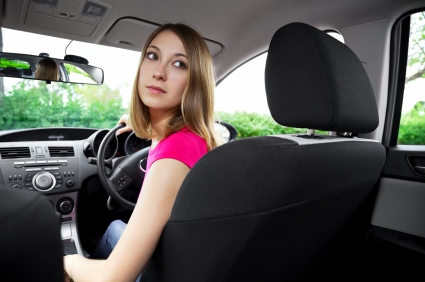 Although this is an example of an instructional approach, a coaching conversation would work really well, too. Yes, top-down approaches will take a little longer in the short-term, but the long-term benefits definitely outweigh this.
So, ask yourself if there is there any more you could be doing to encourage your pupils to have a better awareness of other drivers’ behaviour. How could you work on helping them to communicate better with others on the road? How can we help them be aware of their choices once they’re out there on the road themselves?
*Disclaimer: Throughout these articles, I have referred to drivers who exhibit poor driving behaviour as ‘he’. This is just for ease of writing – it isn’t because I think men are impatient and generally daft drivers at all… honest! 😉
 Have you any further advice for Paul (who originally asked the question about mirrors) that you would like to share? What techniques or strategies have you used with your learners that has been successful? How do you incorporate the skills that kill (using phones, speeding, driving under the influence, showing off, etc) into your everyday teaching?
Please let us know in the comments below – I’m sure it will be appreciated by many.
If you like this article, share it so someone you know might benefit too by hitting one of the social media buttons below.
 “Hi Ged and Claire, I’m getting really frustrated with my pupils not checking their mirrors, they do it sometimes when I ask or tell them to, but then go right back to forgetting again when I stop helping them. What can I do?”
 For the most part, the reason for this is that the learner has no idea what they are specifically looking for. They’ve simply been told or asked to check the mirrors (as in the examples above).
 Appropriately phrased questions will help bring these higher priority things to the learner’s attention – things which they may not have even considered paying attention to, or were ‘blind’ to due to overwhelm.
 Finally, it’s important to notice that the diagram at the start of this article is
  Back when Ged and I were training to become ADIs, the steps for overtaking in ‘The Driving Manual’ were stated as MPSLMSM. This remained the case in seven editions of the updated version of the book (retitled, ‘The Official DSA Guide to Driving: The Essential Skills’). But in the 6th impression (released in 2013), this guidance mysteriously (and without explanation) changed to simply MSPSL
 The latest version (6th impression, 2013) of The Official DSA Guide to Driving: The Essential Skills recommends the MSPSL routine:
 We believe that each method has its place. Most overtaking opportunities arise on multi-lane roads. Because there are extra lanes to use, it’s not necessary to have to cross onto the opposite side of the road. For these types of road, the MSPSL routine is perfectly adequate. However, on two lane two-way roads, the MPSLMSM becomes more relevant and effective. It is imperative that the driver plans more thoroughly with the possibility of meeting oncoming traffic, and that they overtake quickly so they can return to their own side of the road safely and in good time.
 I always remember reading a local news story about a young driver who overtook another vehicle on one of the rural roads near to where we live. He had four of his friends in the car and he hit a single-decker bus coming the other way. The driver and two of his friends were killed instantly, another two were left in a critical condition. It was a shocking (yet all too common) story. I couldn’t help asking myself if we as driving instructors are doing all we can in order to reduce the chances of this happening to those we have taught to drive.
 nowledge and understanding may not have been a factor in the crash. Perhaps the driver just made the DECISION to overtake, regardless of the risks. Maybe he was showing off to his mates, was distracted or thought he was invincible, a lot of young people have the ‘it will never happen to me’ attitude. Perhaps his brain development was a factor – the brain’s pre-frontal cortex, which governs emotion, risk-taking and decision-making, does not fully mature until the age of 25.
 Things have changed a lot in the 16 years I’ve been part of the driving instruction industry, and the way in which I have run my driving school has had to change keep up. One thing that hasn’t changed though is my definition of success.
 4 years later in 2001, I set up a driving school with a business partner, Glyn. We looked to build a multi-car school. This went from strength to strength, with 26 instructors at the height. So what did we do to ensure that outcome?
 Changes we made:
 What doesn’t work well?
 What can work:
 What does work (for us anyway!):
 The Bay Parking Manoeuvre (bay park exercise) can be one of the most frustrating to teach and to learn. Getting the car in between the two white lines first time isn’t always easy, especially from a 90 degree angle to the bay, and when there are no other parked cars in the adjacent bays to help guide you.
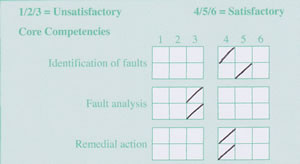 “Hi Ged & Claire. I failed my ADI Part 3 test last week and the examiner told me that although I spotted all his faults and tried to fix them pretty well, my fault analysis needed work. But I’m not sure where I went wrong, because I did what my trainer had told me. For every fault, I asked him why he did it, but he just said, “I dunno” or “not sure”, and at one point he acted really defensive. Is my trainer right, or was my examiner just having a bad day?” Jim (PDI)
 “Hello Ged, I’m looking to get your opinion on the “use of car indicator signals”. A discussion has started up in our local association with regards to following traffic and giving signals.
 “Hey Ged.. I got a really difficult pupil later. Good control of the car but in a ‘boy racer’ way. Very impatient, slightly aggressive to other road users, especially cyclists. He does know all the dangers/hazards but has the ‘it’s their own fault’ attitude. Any advice for dealing with difficult learner drivers?”