 It’s a question we occasionally get asked – “How do I complain about a driving examiner?” Thankfully, we are hearing of fewer and fewer instances of people having issues with examiners’ bad attitudes towards driving test candidates and driving instructors. We have personally found most examiners to be very friendly, professional and approachable. This is likely to be down to the DVSA’s increased emphasis on providing excellent customer service. In this article, we explain how driving examiners are trained and continually assessed. We also look at how you can express your concerns or even complain about a driving examiner, should the need arise.
Firstly, let me share a true story…
Whilst sat in a Driving Test Centre waiting room one day, several nervous driving test candidates awaited the arrival of their examiners. Increasingly loud footsteps prompted their arrival, one by one. Each called the name of their candidate, whilst each instructor anxiously hoped their pupil wouldn’t get… ‘John’. John was the examiner notorious for his extraordinary ability to transform a reasonably calm and confident pupil into a gibbering, nervous wreck within seconds of him meeting them.
John walked into the waiting room, standing tall and firmly holding his clipboard, with his air of authority and self-importance. Without even looking around the room to smile and pleasantly greet the instructors in the room, as all the other examiners did, John called the pupil’s name. “Ben Smith. Can I see your driving licence?” Ben promptly stood up from the seat next to his mum, who had gone with him to the test centre. Clutching a flimsy A4 plastic sleeve full of, mainly unnecessary, documentation such as; his car’s purchase receipt, MOT certificate, insurance policy, theory documents, Highway Code and other paperwork Ben nervously handed John a DL-sized transparent plastic wallet, which held his photo card and counterpart driving licence. In his nervous haste, he dropped the entire contents of the A4 plastic sleeve all over the waiting room floor. As Ben scrambled around the floor to pick up his paperwork, the examiner tossed the driving licence, still in its transparent wallet, onto the table in front of Ben, and said, “Take the licence out of that.” The examiner then turned to stare blankly out of the waiting room window, still clutching his clipboard.  As the seconds passed, he glanced impatiently at his watch whilst Ben gathered his belongings. By this point, Ben was visibly shaken, sweat forming on his forehead, blushing, and rippling with fear. Hardly able to keep his hands steady as he did so, he removed the paper counterpart and plastic card from the DVLA stamped plastic wallet and handed it to John.
As soon as the door to the test centre closed behind the last examiner and test candidate, Ben’s mum looked over at all the instructors in the room and said, “Wow – what a horrible, horrible man. Is he always like that?” We all nodded in agreement – Ben had drawn the short straw.
Why is it that the vast majority of driving examiners can be pleasant and able to put pupils at ease, whilst a very small number of others can turn the test candidate into a fearful mess before they even get into the car? How can it be fair? And as instructors, can we, and should we, do anything to complain about a driving examiner?
 We all have bad days
It’s true that we all have our bad days – we all have personal ‘stuff’ going on in our lives that can sometimes negatively impact our mood. I’m sure that being an examiner can be quite challenging at times. Some Approved Driving Instructors might say that it’s the same for us. In an ideal world, we would all keep our personal stuff hidden – ‘fake’ a good mood so that our personal baggage doesn’t impact on our work. But let’s face it, we’re all human and from time to time, others might notice our aura of discontentment.
But that is not what this article is about. We’re discussing those examiners that have a reputation for instilling fear in test candidates or those that show little respect towards driving instructors – those who could at times be described as negative, condescending, arrogant or even rude. Thankfully these examiners are few and far between, but we’ve received enough feedback about it to take some time to provide you with an insight into how examiners are trained and assessed in terms of providing a positive customer experience, and what you, or your pupil, can do about it if you feel particularly aggrieved by an examiner at your test centre.
“How are examiners initially assessed and trained in customer service?”
 During a recent visit to the DVSA’s Training & Development Centre in Cardington, Bedfordshire, we learned more about the examiner training process and we asked a senior trainer to what extent personality traits and attitudes are taken into account when examiners are trained. We also learned how the DVSA openly welcome feedback from driving instructors and driving test candidates, especially when someone feels the need to complain about a driving examiner due to their attitude or general manner.
We were pleased to learn that potential candidates for the position of driving examiner are assessed on their personality characteristics and customer service throughout the whole process, from the initial application form through to final test centre placement, and beyond.
All trainee examiners must undertake Situational Judgement Tests during training – some of these are scientifically designed to highlight any issues in respect to personal thought processes and responses. In addition, job-related role play assessments take place, in which professional actors are used in problem scenarios to see how the trainee examiner responds. This, again, highlights strengths and weaknesses in their ability to deal with members of the public.
Throughout their time at the Training & Development Centre, trainee examiners are continually assessed against 4 core competencies:
- Control of the test
- Assessment of the test
- Completion of paperwork
- Customer service
 The ‘customer service’ element looks at how the trainee examiner relates to, and communicates with, everyone else during their 4-6 week training course. In life beyond the course, everyone that examiner could come into contact with in their working life is defined as the ‘customer’. This, of course, includes learner drivers and their instructors.
Trainees are closely observed on how they communicate with the test candidate during role play driving tests and to the trainers providing feedback and classroom training throughout the programme. Communication and behaviour during social gatherings, meal breaks, and even smoking breaks, is subtly scrutinised – this includes the trainee’s relationship with their fellow candidates, trainers and other staff members at Cardington, even extending to the cleaners, canteen and hotel staff. Nothing goes unnoticed.
In learning about customer service, trainee examiners are taught the need to be fully aware of, and adapt; their body language, the way they observe the candidate, their seating position, respect of the candidate’s personal space, suitable levels of eye contact, appropriate tone of voice, etc. A large part of customer service training is centred around how verbal and non-verbal communication can be interpreted, or misinterpreted. Therefore, all qualified examiners should be aware that it is how their verbal and non-verbal communication is interpreted by others that is important – more so than the intention behind that behaviour.
 When training and assessing candidates for driving examiner positions, senior training staff at Cardington are looking for people with specific personal characteristics and customer service skills. They need to have a calm confidence, especially when in confrontational situations. But they equally need to be reassuring when dealing with test candidates who have emotional outbursts.
“Yes, but what happens after placement at a driving test centre?”
It’s all well and good for a trainee examiner to be able to demonstrate good customer service skills whilst in the presence of senior trainers at the DVSA Training Centre, but what happens when they’re out there in the real world? Isn’t this when the problems start?
 The training team at the DVSA acknowledge the fact that no matter how many assessments, role plays and Check Tests are conducted during training and whilst out there on the job, trainee and qualified examiners are often able to ‘play the game’ when being assessed. Their actual conduct whilst out there on the job could be something entirely different. During a trainee examiner’s initial training programme, the environment at the Training Centre is very positive, and as such, the trainee examiners’ behaviours are positively influenced by those around them.
This same influence will affect them after they are placed at a driving test centre. They will continue to be influenced by their peers – if a more long-standing examiner, working closely alongside them, has poor attitudes, then the new examiner is much more likely to mimic their behaviour.
For the first 9 months, which includes the 4-6 week training period at Cardington, each new examiner is on probation. They are very closely supervised by either the LDTM (Local Driving Test Manager) or an experienced examiner at that particular test centre. During the first month, each new examiner has one day per week devoted to development – this takes the form of 4 supervised practical driving tests, 16 in total for the month, and time for discussion after each test. Assuming all goes well on those 16 supervised tests, each new examiner will continue to have one development day per month for the next 3 months, equating to a further 12 supervised tests.
In addition to the above, each new examiner will shadow another more experienced examiner from time to time, and be routinely assessed by a member of the QUAT (Quality Assurance Team) to ensure the new examiner is continuing to demonstrate the 4 core competency skills.
Outside the above 4 month period, all examiners will have a minimum of 6 check tests per year, assessed by their LDTM, plus further QUAT assessments. In total, most examiners will have approximately 12-15 check tests / assessments per year. And to think – we ADIs often moan about having 1 or 2 in every 4 year period!
“How do I complain about a driving examiner’s poor attitude and customer service?”
An examiner may appear to come across, intentionally or otherwise, as; negative, condescending, ignorant, rude, malicious, intimidating or bullying. Most of these examiners may be totally unaware of it. Their fellow colleagues may feel that they are not in a position to challenge it for fear of reprisals. Nevertheless – it still needs addressing. Do not be afraid to be the one to complain about a driving examiner to the DVSA – if nobody says anything, nothing will change.
 If you or your pupil have an issue with an examiner’s customer service skills, the first point of contact should be with your LDTM. If you are unsure who that is, check on the local notice board in your driving test centre. If it is not there, you could either ask another examiner for the contact name and number of the LDTM, or call the DVSA on 0300 200 1122 and ask the advisor for the information.
Once you have your LDTM’s contact details, either have a telephone conversation with the LDTM or arrange a meeting with them to discuss how you, or your pupil, perceived the examiner’s behaviour. Express your concerns honestly and respectfully, remembering that the examiner concerned may not be intending to come across in that way. It’s important that your issues are conveyed in the right manner and for the right reasons. Remain calm and professional.
Listen to what the LDTM has to say – they should follow up your discussion by speaking directly to the examiner concerned about how their behaviour is coming across. If after having done so, you still experience issues with that particular examiner, put your complaint in writing. Written complaints MUST be followed up by senior management, so rest assured that your issue will definitely be addressed.
Remember – unless ADIs and/or customers express their concerns about such examiners, nothing can be done.
We do find that instructors often avoid complaining about a driving examiner’s conduct for fear of retribution from that examiner. We know this has happened on some occasions but thankfully, such problems are very rare. If an examiner does have an undesirable attitude, there’s likely to be little change unless the DVSA are made aware of it.
 Thankfully, Claire and I have personally found examiners’ customer service skills to be excellent, on the whole. On the rare occasion that we have encountered issues, we have never been afraid to confront this issue, either directly with the examiner themselves or by contacting a more senior member staff at the DVSA. Incidentally, we have never defined the reason for our contact as being a ‘complaint’ – instead we discuss our ‘concerns’ or ‘observations’. Each time we have done so, the senior examiner has been very grateful for our feedback and has followed up on our concerns. In each and every case, we have found noticeable improvements, with no open detriment to that examiner’s attitude towards us.
 How do you find customer service at your local test centre?
Do you have an examiner with a notorious reputation for his or her attitude?
Have you, or one of your pupils, ever felt the need to complain about a driving examiner?
If so, how have you dealt with it?
Might you handle things differently in the future as a result?
Please share your thoughts below – we love hearing from you and learning from your experiences! And remember, if you can think of someone that would benefit from this article, please hit one of the buttons below and SHARE it!
*Please note that the names within the story above have been changed to protect their real identities.

 Reflective logs (or journals) are nothing new – they have been used very successfully for many years in other educational establishments, including some primary and secondary schools. Therefore, it’s quite possible that your pupils will be very familiar with the process, even if it might feel alien to you.
 This enabled me to keep a track of not just what we covered and when, but specifically how well my pupils carried out those tasks and where they needed to improve. Together, we would then plan what to cover next lesson (although admittedly I frequently ‘led’ the pupil with this decision).
 It is most beneficial for the pupil to write the log themselves so that they don’t censor their thoughts and feelings. However, as long as the record is a true and honest reflection of the pupil’s thoughts and feelings, it shouldn’t matter too much who does the writing. Personally, I have found that most clients prefer me to take the notes whilst they are reflecting on the progress and expressing their thoughts verbally. I then summarise what they’ve said and enter it onto the log. This also saves lots of time.
 Make it a normal part of your lesson and your pupils will accept it. In every educational setting, lessons have a start (recap), middle (learning) and an end (recap/debrief), so why should driving lessons be any different?
 Some instructors supply each of their pupils with a ‘Starter Pack’ when they start lessons (which might include a branded pen, terms and conditions, Highway Code, referral vouchers, etc). Adding an inexpensive blank notepad to this pack, labelled ‘Reflective Learning Record’ is one idea. Who keeps the learning record is entirely up to you, although in my experience 17 year olds can be quite forgetful. If you intend to leave the learning record with your pupil, you’ll need a plan in place for when they forget it, or it gets ‘eaten by the dog’.
 The DVSA have conveniently supplied a sample reflective log in their
  You could
 If you have access to an iPad, check out the ‘
 There are also many advantages of using a Facebook business page – insights, customer star ratings, reviews and advertising being just a few. For a list of 14 benefits of a Facebook Business Page over a Personal Profile, take a look at
  In the Facebook header bar, click on the drop down arrow on the far right and click ‘Create Page’. It’s probably best to opt for a ‘Local Business or Place’ as you will be wanting to let people know where you are based. Although your address will show on your page, you don’t have to add your house number if your work address is the same as your home address. On the category dropdown list, just opt for ‘Local Business’ for now. Complete all your details and click ‘Get Started’.
 Choose an appealing profile picture. A smiley picture of you in your car will appeal to potential customers. People buy from people so make your page as personable as possible. Using your company logo isn’t usually a good idea – your potential clients aren’t interested in a logo – they want to see who they are going to be buying from. If you’re photo-shy or perhaps feel your photo might turn potential customers away, then perhaps use a photograph of a happy pupil, smiling broadly with their driving test pass certificate. Please don’t be tempted to rip a photo from Google images or use a stock photo – your profile image is your first point of contact from which your potential customers will glean their first impression. Make sure it’s a good one!
 Make sure you also utilise the ‘About’ section on your business page. Let potential customers know that you can offer what they want. The about section also lets you add hours of opening, a contact number and links to other social media sites that you may use (Twitter, Pinterest, Google+, Instagram, etc). Make sure you include links to your company website.
 Use your cover photo wisely. Again choose an appealing photo for your cover but then add words including a clear call to action. For example, below you can see the cover photo we used this Spring on our Facebook business page – ‘Call us now and pass for Summer! 0161 345 3452’. Also make sure you add a description so when people click on the cover image there are more details and further calls to action, e.g. ‘Start learning now and take advantage of our great deals! Call us: 01234 567 890, Visit our website: www.drivingschool.com, Follow us on Twitter: @drivingschool’
 So that’s how to set up your Facebook page in 6 easy steps. Easy, wasn’t it?!
 “Hi, Ged & Claire. Like most ADIs, I really enjoy all your articles and posts, so keep it up! I was, however, wondering if you could offer some advice on improving driving test pass rates…
 If you want to know what you’re good at and what you could improve on, measure your results. Taking a photo of the driving test report or copying a test report onto a blank one will allow you to keep records of what your learners are picking up faults on. Is there a trend? When I did this, I found that I was getting quite a few driver faults on mirrors, including the odd serious one. I decided to remove my eye mirror, and the learners became aware of when I was watching them. This prepared them for being watched by the examiner, and also became a subliminal prompt. After that, my mirror faults decreased significantly!
 This has always been a particular challenge for me. Even on ‘mock’ tests, and certainly in the lessons on the run up to the test, it’s easy to overlook how much help you are actually giving your learners. Getting them used to total independence for set periods of time will not only prepare them for the test conditions, but also give you insight into how much you actually help them without thinking about it!
 Tip 5 – Say NO!
 Top 8 – Deal with test day ‘nerves’
 “Hi Ged and Claire, I’m getting really frustrated with my pupils not checking their mirrors, they do it sometimes when I ask or tell them to, but then go right back to forgetting again when I stop helping them. What can I do?”
 For the most part, the reason for this is that the learner has no idea what they are specifically looking for. They’ve simply been told or asked to check the mirrors (as in the examples above).
 Appropriately phrased questions will help bring these higher priority things to the learner’s attention – things which they may not have even considered paying attention to, or were ‘blind’ to due to overwhelm.
 Finally, it’s important to notice that the diagram at the start of this article is
  ADI Diary Management and Diary planning is an art form in itself. Learning to plan your diary efficiently can help maximise your time, boost your profits and reduce your fuel costs. It also enables you to ‘work to live’ rather than ‘live to work’. Many new instructors struggle with diary management, so here are 7 tips on how to manage your diary more effectively, based on our own experiences. We hope you find the ADI diary management tips useful!
 So what day(s) off do you want? What time do you want to start and finish work? Ok, so you may have to make the odd exception to fit in that new pupil on their birthday but having strict parameters will help you keep work contained within the times and days YOU want.
 Try to narrow down your coverage area, where possible. Yes, that’s easier said than done for some people. If you’re a new ADI, you’ll probably have to start with a wide geographical area and narrow it down as you get busier. Or it may be that you live in an area that’s not densely populated.
 I know what you’re thinking… “Say NO? You’re kidding right?!”
 Time is precious. And for driving instructors, lost time equals lost income. Using the top ten tips to Reduce Driving Lesson Cancellations can save you time and money. Yes, it’s great to be able to catch up on other essential business matters when last-minute lesson cancellations arise, but we all have bills to pay. So what can we do to minimise cancellations and loss of income? Here are 10 top tips:
 Outline the conditions for cancellation (see below) and end the conversation by simply asking for their verbal understanding, “so are we OK with that, or do you need me to clarify anything?”
  Make your terms and conditions easily available, have them on your website and appointment cards. Go through cancellation policies at the time of booking and/or on the first lesson. Even so, it can be hard to enforce and if reliable customers have a genuine reason for cancelling, waiving the cancellation on that occasion can make good business sense. You don’t want to lose an otherwise reliable customer all because you charged her for a lesson when she was in hospital with her son.
 “Yes Ged, I tell them that they have to give me 48 hours’ notice of any cancellations, otherwise I’ll charge them. But obviously if they’re ill, I don’t want their germs, so it’s fine to cancel then” When I asked him what the pupils’ reasons for cancelling that week was, can you guess what his reply was? Yes, you got it – “they’re all ill”. Hardly surprising, was it? It’s a good idea to waive the lesson fee if your pupil is genuinely poorly, but don’t tell them in advance that this will be the case, or else the same excuse will be used every time they just can’t be bothered with their driving lesson!
 When lessons are moved around a lot it’s easy for the pupil to ‘forget’ when their lesson was or double book that lesson time with some other commitment. Also, bear in mind that if you keep changing their lesson time around from week to week, they’ll expect you to allow them to do the same. Having said that, do bear in mind that learners will benefit from experiencing driving at different times of day, so moving a lesson time to another ‘regular slot’ for a few weeks should work well.
 It’s much easier to charge for cancellations when you have the money up front. Block booking discounts offer an incentive for customers to pay for 10 hours at a time, but is your incentive enough? We noticed a big difference in the amount of pre-payments for blocks of 10 hours when we put our hourly rate up but kept the block booking the same. Instead of a £10 discount, customers get £20 discount (almost the price of a 1 hour lesson!). Now customers are much more likely to take advantage of the £20 saving.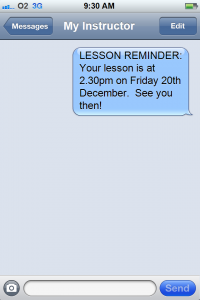
 Another great question was sent in to us this week – this time about dealing with aggressive drivers. Find more information about what to do and how to deal with aggressive tailgaters and angry drivers during a driving lesson.
 Black Dragon Kick Boxing
 For some reason, many instructors report that using a roof sign can attract a greater number of other drivers ‘making poor decisions’ than when just displaying L plates alone. We’re not entirely sure if this is actually true or just a false perception. If it is true, it may be that others may:
 Or, you can choose to be calm, not rise to it, remain neutral and enjoy the rest of your day… and suffer no extra wrinkles! The choice is yours.
 “Hi Ged & Claire. What do I do about a pupil that doesn’t seem to want to learn? He keeps paying me for lessons, but pulls up and demands to get out for a smoke when things aren’t going so well. I think he spends more time smoking than he does driving. I really feel like I’m wasting my time with him and I hate feeling like this. I love my job and I just want to teach! But how can I motivate him to want to learn?”
 During his lessons, Marc seemed quite disinterested. He seemed to ‘plateau’ for a few lessons, and I was struggling to help him to improve. At the end of one particular driving lesson in which Marc hadn’t really shown much improvement, we pulled up outside his house. He wasn’t forthcoming with his feedback when I encouraged him to self-reflect on his progress. So I chose to ask him, “Why is it you want to learn to drive, Marc?” “I don’t”, came his reply. “So why are you having driving lessons?” I asked him. “Cos my dad wants me to”. Marc’s dad ran a successful Italian restaurant and a takeaway pizza parlour. It turned out that Marc’s dad had him lined up to do the pizza deliveries, hence was financing Marc’s driving lessons.
 To be quite frank, I didn’t enjoy teaching Marc. He was the perfect definition of what I would term a ‘mood hoover’ or ‘energy vampire’ – over the course of a 1 hour driving lesson, he had this amazing ability to suck every piece of enthusiasm out of me and turn me from a happy, inspiring, smiley driving instructor to a sullen-faced, unmotivated instructor, who felt like packing it all in and getting a ‘proper’ job.

 Back when Ged and I were training to become ADIs, the steps for overtaking in ‘The Driving Manual’ were stated as MPSLMSM. This remained the case in seven editions of the updated version of the book (retitled, ‘The Official DSA Guide to Driving: The Essential Skills’). But in the 6th impression (released in 2013), this guidance mysteriously (and without explanation) changed to simply MSPSL
 The latest version (6th impression, 2013) of The Official DSA Guide to Driving: The Essential Skills recommends the MSPSL routine:
 We believe that each method has its place. Most overtaking opportunities arise on multi-lane roads. Because there are extra lanes to use, it’s not necessary to have to cross onto the opposite side of the road. For these types of road, the MSPSL routine is perfectly adequate. However, on two lane two-way roads, the MPSLMSM becomes more relevant and effective. It is imperative that the driver plans more thoroughly with the possibility of meeting oncoming traffic, and that they overtake quickly so they can return to their own side of the road safely and in good time.
 I always remember reading a local news story about a young driver who overtook another vehicle on one of the rural roads near to where we live. He had four of his friends in the car and he hit a single-decker bus coming the other way. The driver and two of his friends were killed instantly, another two were left in a critical condition. It was a shocking (yet all too common) story. I couldn’t help asking myself if we as driving instructors are doing all we can in order to reduce the chances of this happening to those we have taught to drive.
 nowledge and understanding may not have been a factor in the crash. Perhaps the driver just made the DECISION to overtake, regardless of the risks. Maybe he was showing off to his mates, was distracted or thought he was invincible, a lot of young people have the ‘it will never happen to me’ attitude. Perhaps his brain development was a factor – the brain’s pre-frontal cortex, which governs emotion, risk-taking and decision-making, does not fully mature until the age of 25.